
Slab Leak Detection in Lewisville, TX
Water bill jumped with no change in usage? Warm patch on the floor? Running water you can hear with every tap off?
Leak detection in Lewisville starts with finding the leak, not opening your floor to hunt for it. We locate it within inches first, then talk about how to reach it.
Master Plumber M-46550 · Licensed & Insured · Open 24/7
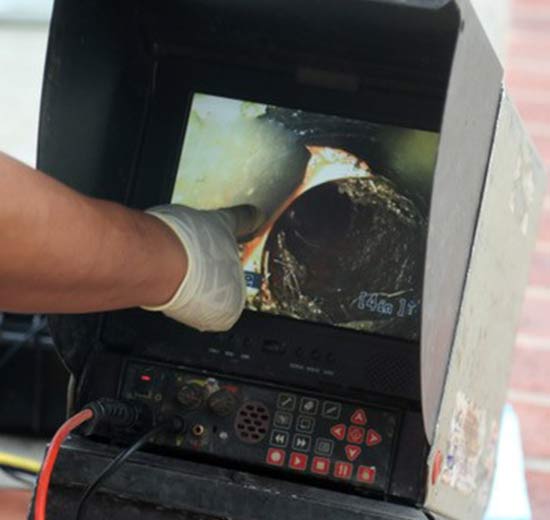
Signs of a Slab Leak
- Water bill up with no change in how you use water
- A warm or damp patch on the floor, often in one spot
- Water pressure dropping across the house
- The sound of running water when everything is shut off
- New cracks in flooring, tile grout, or along a wall
- A musty smell with no obvious source
- Flooring lifting, warping, or discolouring
A warm patch is the clearest single sign. It usually means a hot water line under the concrete is leaking, and heat is transferring up through the slab.
Try this yourself first. Shut off every fixture, including the ice maker and irrigation. Find your water meter and note the small dial or triangle — the leak indicator. Wait 15 minutes and check again. If it moved, water is escaping somewhere with everything off.
Why Slab Leaks Are So Common in Lewisville
Lewisville grew up mostly in the 1970s and 80s — the city went from roughly 46,000 people in 1990 to about 78,000 by 2000, and much of the housing stock predates that.
Homes from that era were plumbed with copper water lines running under the concrete slab. Those lines are now 35 to 50 years old, which is precisely the window where copper under a slab starts developing pinhole leaks.
Three things cause it, and they compound:
Age and water chemistry. Copper corrodes slowly from the inside, and over decades that produces pinholes rather than a single break.
Soil movement. Clay soil here swells with rain and shrinks in drought. A rigid copper line embedded in or beneath concrete has nowhere to go, and that stress concentrates at bends and fittings.
Abrasion. Lines that move even slightly against the slab or against gravel wear thin at contact points.
It’s a normal end-of-life pattern, not bad luck. If your house is from Lewisville’s growth years and you’re seeing these signs, you’re on schedule rather than unlucky.
Newer neighbourhoods behave differently. Later construction in Castle Hills and parts of Vista Ridge uses PEX, which tolerates ground movement far better. Leaks there are more often at a fitting, a supply line to an appliance, or the yard line — not the slab.
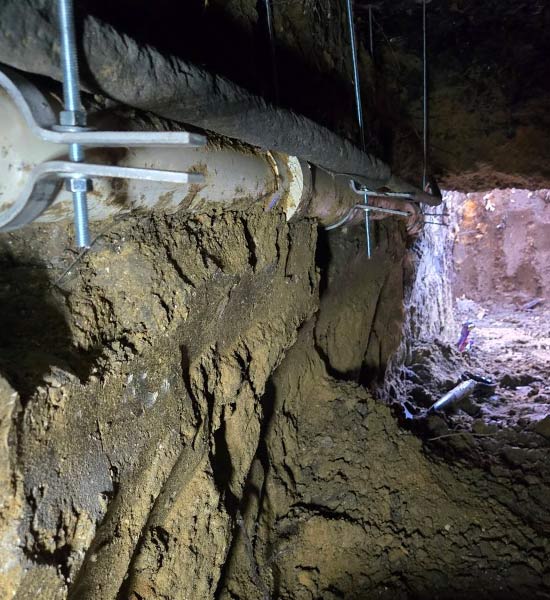
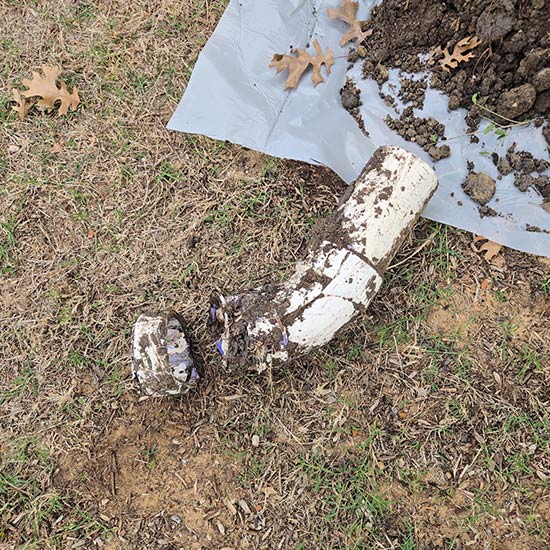
How We Find It
We locate before we open anything. That order is the whole job, and it’s what separates real leak detection from guesswork.
- Confirm there’s a leak — meter test, then a pressure test to isolate the supply system from everything else
- Determine hot or cold side — narrows it immediately and often explains the warm spot
- Narrow the location — acoustic listening equipment picks up water escaping under concrete, worked down to within inches
- Confirm before committing — sometimes with a camera, sometimes by isolating sections
- Show you what we found, then give you options in writing
A leak located precisely is a small, targeted repair. A leak guessed at becomes a much larger hole in your floor and a much larger bill.
Ask any plumber how they locate a slab leak before you let them quote fixing one. If the answer is vague, keep calling.
Your Repair Options
Spot repair — open a small section of slab, repair the line, close it. Best for a single leak in an otherwise sound system.
Reroute — abandon the run under the slab and run new line overhead through the attic or walls. Frequently cheaper and far less disruptive than concrete work, and it takes that section out of the slab permanently.
Repipe — for homes with repeat failures, replacing the affected system rather than chasing leaks one at a time. Worth considering seriously on a second or third slab leak, because a fourth is coming.
You get the options with prices before you decide. Companies that always open concrete usually do it because it’s the only method they have.
Other Plumbing Services in Lewisville
Lewisville Slab Leak FAQs
How long does it take to find a slab leak?
Most residential jobs are one to three hours to locate. Confirming a leak exists is quick; pinpointing it under concrete takes longer, and it’s time well spent — every hour narrowing the location saves considerably more in unnecessary demolition.
Should I reroute or do a spot repair?
Depends on where the leak is and the age of the system. A single leak in otherwise sound pipe is usually a spot repair. If the run is long, awkward to reach, or you’ve already had a leak on the same line, rerouting overhead often costs less and removes the risk permanently. We price both.
Can a slab leak damage my foundation?
It can, over time. Persistent water under a slab changes the moisture content of the soil supporting it, and in expansive clay that means movement. That’s a reason to act rather than monitor — the plumbing repair is almost always cheaper than what follows if it runs for months.
How much can a slab leak add to my water bill?
Enough to notice clearly. A pinhole running continuously wastes thousands of gallons a month. If your bill has jumped noticeably and your habits haven’t changed, treat that as a real signal rather than a billing error.
Should I shut my water off while I wait for you?
If you can hear water running or you’re seeing active damage, yes — shut it at the main and open a low faucet to drain the lines. If it’s a slow leak with no visible damage, leaving water on until we arrive is usually fine. Tell us what you’re seeing when you call and we’ll advise.
My house is in Castle Hills. Am I at risk?
Less so. The newer parts of Castle Hills and Vista Ridge were built with PEX, which handles ground movement far better than copper. Leaks in those homes are more often at a fitting, an appliance supply line, or the yard line rather than under the slab. Still worth running the meter test if your bill has jumped.
Think You Have a Slab Leak in Lewisville?
Run the meter test, then call us with your build year and neighbourhood. That gets us most of the way to knowing what we’re looking for.