
Water Line Repair & Replacement
Water Line Repair & Replacement in Dallas, TX
Experiencing low water pressure, sudden spikes in your water bill, or wet spots in your yard? Wise Choice Plumbing & Rooter specializes in professional water line repair and replacement in Dallas and throughout the DFW area. Our licensed technicians use advanced leak detection to accurately locate problems and perform reliable repairs or replacements with care for your property. From leaking pipes and broken mains to outdated galvanized lines, we provide fast, dependable solutions with upfront pricing and no hidden fees. Protect your home from major water damage and restore strong, clean water flow today.
Our Water Line Services in Dallas
- Water Main Line Repair & Replacement
- Burst Pipe Repair
- Traditional Excavation when needed
- Leak Detection with Advanced Technology
- Galvanized, Copper, and Poly Pipe Repair/Replacement
- Water Meter to House Service Line Repairs
- Low Water Pressure Solutions
- Hydrostatic Testing
- Emergency Water Line Burst Service
- Full Service Line Upgrades
Call Now for Water Line Repair & Replacement in Dallas: 24/7 Emergency Service Available
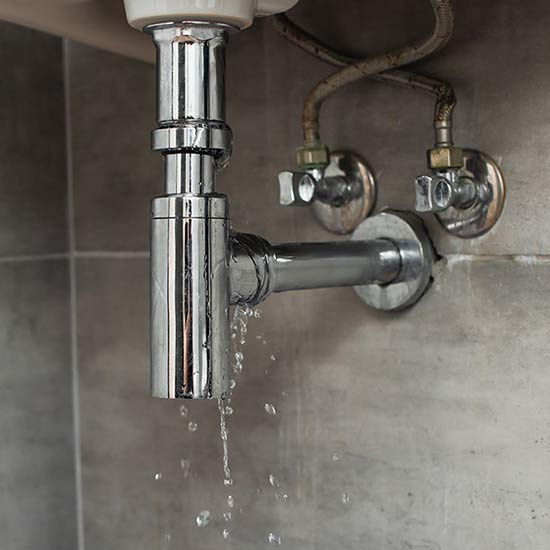
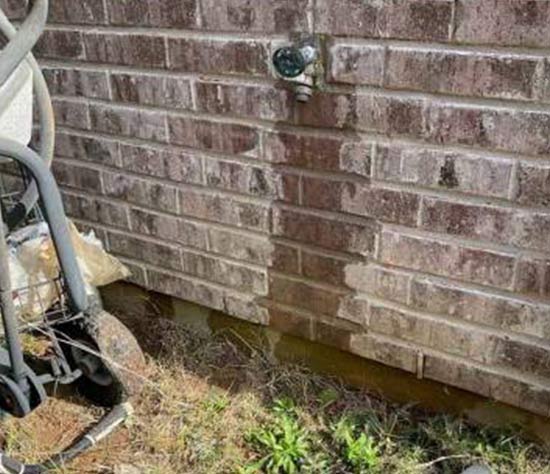
Signs You Need Water Line Repair in Dallas
- Water bill up with no change in how you use water
- Low pressure at every fixture rather than one
- Pressure collapsing whenever a second tap opens
- A damp, soggy, or unusually green patch in the yard
- Rusty or discoloured water, especially first thing in the morning
- The sound of running water with everything shut off
- A depression or soft spot forming in the yard or driveway
- Sediment or grit in the water after a repair elsewhere on the street
One quick test, and it costs nothing. Shut off every fixture in the house, including the ice maker and the irrigation system. Find your water meter — usually in a covered box near the street — and look at the small dial or triangle on the face. That’s the leak indicator. Note where it sits, wait fifteen minutes, and look again.
If it moved, water is escaping somewhere with everything off. That won’t tell you where. It does tell you there’s something real to find, which is worth knowing before you call anyone.
Three Different Lines, Three Different Jobs
Most homeowners think of “the water line” as one thing. It’s really three, and which one is failing changes the work completely.
The service line, meter to house. Buried, usually the longest single run, and the one most exposed to ground movement. North Texas clay swells with rain and shrinks in drought, and that works on any joint or weak point over time. A soggy patch in the lawn that persists through dry weather is the classic sign. On larger lots this run can be substantial, and it often passes under a driveway.
Lines under the slab. In homes built from roughly the 1970s through the 1990s, copper supply lines frequently run beneath the concrete. After thirty to fifty years copper under a slab develops pinhole leaks. The symptoms are different — a warm patch on the floor, a musty smell, cracks in flooring. That’s a slab leak, and it’s located differently.
Interior distribution. The pipe running through walls and ceilings to your fixtures. In older Dallas homes this can still be galvanized steel, which is the single most common cause of whole-house pressure loss we see.
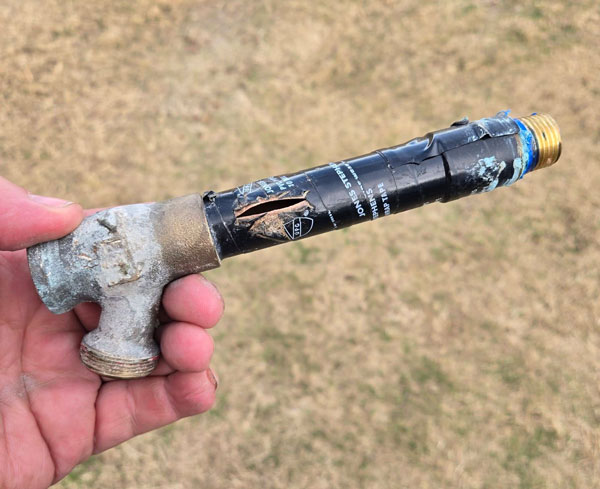
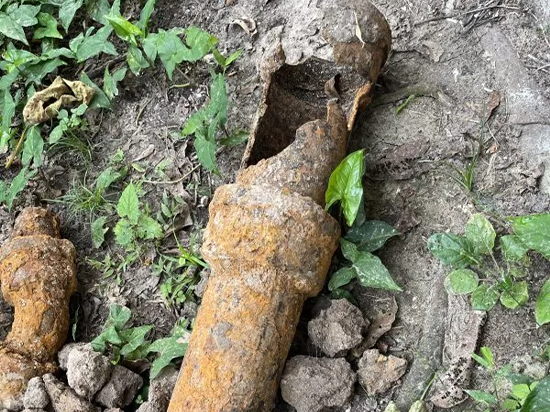
Why Galvanized Pipe Causes Low Pressure
If your home was built before about 1970 and pressure has declined gradually over years, this is almost certainly it.
Galvanized steel corrodes from the inside. Rust builds in layers on the interior wall until the usable opening is a fraction of the original bore. From the outside the pipe looks perfectly sound. Inside, a three-quarter-inch line might have a quarter inch of usable space left.
So the complaint is “low water pressure,” but the pressure arriving at your house is normal. The pipe simply can’t deliver it.
It degrades in a recognisable order: furthest fixtures first, then anything upstairs, then pressure collapsing whenever someone opens a second tap. Rusty water first thing in the morning — after it’s been sitting in the pipe overnight — is the other giveaway.
There’s nothing to clean. The pipe wall itself has closed inward. The only fix is replacing the affected runs.
How to Tell What You Have
Look at exposed pipe in the garage, a utility closet, or under a sink:
- Dull grey metal, and a magnet sticks to it — galvanized steel. Pre-1970s.
- Reddish metal — copper. Roughly 1970s through 2000.
- Flexible plastic tubing, usually white, red or blue — PEX. Post-2000.
If you can’t find exposed pipe, the build year is a reliable guide. Your county appraisal district has it and it’s free to look up.
Our Professional Water Line Process
- Accurate Diagnosis — We use electronic leak detection, acoustic sensors, and camera inspections to pinpoint the exact issue without unnecessary digging.
- Clear Options — Honest recommendations with video/photos and transparent pricing for repair vs. full replacement.
- Expert Repair/Replacement — Professional repair and replacement performed cleanly and efficiently.
- Pressure Testing — We verify the new line holds proper pressure and has no leaks.
- Site Restoration — We clean up and restore your property to its original condition.
Why Choose Wise Choice for Water Line Service in Dallas?
- Locally owned and operated in the DFW area
- Advanced leak detection
- Licensed, insured, and experienced crew
- Upfront pricing — never any surprise charges
- 24/7 emergency water line repairs
- Same-day diagnostics in most cases
- Satisfaction guaranteed
- We treat your home and property like our own
Serving all Dallas neighborhoods: Uptown, Lake Highlands, Oak Cliff, East Dallas, Plano, Frisco, Garland, Irving, Richardson, Mesquite, Arlington, and the entire DFW metroplex.
Losing Pressure or Water Somewhere?
Run the meter test, then call us with the age of your house. Those two things get us most of the way to a diagnosis before we arrive.

Upfront Pricing & Flexible Payment Plans
Call us today at (945) 291-8008

Water Line Repair FAQs
Who is responsible for the water line from the meter to my house?
Generally you are. The utility typically owns the main and the meter; the line running from the meter onto your property is the homeowner’s. That’s why a soggy patch in the front lawn is usually your repair rather than the city’s. If you’re unsure which side of the meter the leak is on, we can establish that before any digging starts.
What causes a sudden drop in water pressure, as opposed to a gradual one?
The timing tells you a lot. Gradual decline over years is almost always corrosion narrowing the pipe from the inside. A sudden drop points at something discrete — a burst section, a failed pressure reducing valve, a partially closed main shut-off after other work, or a problem on the utility’s side. Sudden changes are worth reporting quickly; gradual ones are a planning conversation.
What is a pressure reducing valve, and do I need one?
A PRV sits near where the main line enters your home and lowers incoming pressure to a safe range. Municipal pressure can run higher than residential fixtures are designed for, and excessive pressure shortens the life of valves, supply lines, and water heaters. When a PRV fails it usually fails toward low pressure, which is why it’s worth checking before assuming you have a pipe problem.
Can a water line leak damage my foundation?
It can, over time. Persistent water under or beside a slab changes the moisture content of the soil supporting it, and in North Texas expansive clay, changing soil moisture is what moves foundations. That’s a reason to address a known leak rather than monitor it — the plumbing repair is almost always cheaper than what follows if it runs for months.
Can you replace just the section that's leaking?
Often, yes, when the rest of the run is sound and we’ve located the failure precisely. On older galvanized it’s usually a false economy, because the remaining pipe is the same age and material. We’ll be straight about which situation you’re in.
What is trenchless water line replacement?
Trenchless methods replace a buried line with minimal excavation — typically small access pits at each end rather than an open trench along the full run. It isn’t right for every situation; the existing line’s condition, depth, and route all determine whether it’s viable. Where it works, it avoids tearing up driveways, mature landscaping, and paving. We’ll tell you honestly whether your line is a candidate.
My pressure is fine but my bill is high. What else could it be?
Pressure and volume are different things — a leak can waste a great deal of water without reducing pressure at the tap. Start with a running toilet, which is the most common and cheapest culprit, then irrigation, then an underground leak. The meter test settles whether water is escaping somewhere before you spend money looking.
Do I need a permit for water line work?
Generally yes, for replacements and most repairs. Requirements vary between cities in the metro, and several require contractors to be registered before a permit can even be submitted. We pull the permit and schedule the inspection.
Water Line Repair Near You
We handle water line repair across Dallas and the surrounding communities, including Denton, Lewisville, Little Elm, Frisco, Plano, Carrollton, and Richardson.
Related: leak detection · hydrostatic testing · sewer line repair