
Water Softener Installation & Repair in Dallas, TX
Here's something most people in this area don't know: hardness varies by more than double across the DFW metroplex, depending entirely on which water district supplies your city.
A softener sized correctly for a home in Frisco is oversized for Carrollton and badly undersized for Flower Mound. Which is why sizing a water softener in Dallas from a figure you found online is how people end up with a system that regenerates constantly, burns through salt, and still leaves crust on the shower door.
We test your water at your address before sizing anything.
Master Plumber M-46550 · Licensed & Insured · Open 24/7
Water Hardness Across the DFW Metroplex
Hardness here is set by which wholesaler supplies your city, not by geography. Four different districts feed the metroplex, and the spread between them is wide.
| Supplier | Approx. hardness | Cities served |
|---|---|---|
| Tarrant Regional Water District | ~6–10 gpg | Fort Worth, Arlington, and much of Tarrant County |
| Dallas Water Utilities | ~8–8.6 gpg | Dallas, Irving, Carrollton, Lewisville |
| North Texas Municipal Water District | ~11–12 gpg | Plano, Frisco, McKinney, Allen, Richardson, Garland, Mesquite, Rockwall, Wylie, Little Elm, Prosper |
| City of Denton | Higher end for the region | Denton |
| UTRWD + Dallas blend | ~12–20 gpg | Flower Mound |
| Trinity River Authority + Lake Grapevine | ~7.1 gpg | Grapevine |
Anything above 7 gpg is classed as hard water, so most of the metroplex qualifies. But the spread is the part that matters.
Flower Mound can run more than double Fort Worth. A softener correctly sized for a home in Frisco is oversized for Carrollton and badly undersized for Flower Mound — and a system sized off a Fort Worth figure would be wrong for most of the northern suburbs.
Two places where it gets more complicated:
Flower Mound takes treated water from two wholesale suppliers with separate delivery points, which is why published figures for the town vary so widely. Testing at your own address matters more there than almost anywhere in the metro.
Fort Worth and Arlington are the softest major supply here, which surprises people who assume all North Texas water is the same. It’s still hard by national standards — it just isn’t in the same range as the NTMWD cities.
Don’t copy a neighbour’s setup from another city. It’s the most common reason we’re called out to a softener that isn’t doing its job.
How a Water Softener Actually Works
Worth understanding, because it explains everything that goes wrong with them.
Hard water passes through a tank of resin beads carrying sodium ions. Calcium and magnesium — the hardness minerals — swap places with the sodium and stay behind on the resin. Softened water continues to your house.
The resin eventually fills up with hardness minerals and stops working. So the system regenerates: it flushes the resin with brine from the salt tank, washes the accumulated minerals down the drain, and recharges the beads with sodium.
Three things follow from this:
Sizing is about grain capacity, not house size. A softener is rated for how many grains of hardness it removes between regenerations. Your daily requirement is your water use multiplied by your hardness. Get the hardness figure wrong and the sizing is wrong.
An undersized unit regenerates too often, wastes salt and water, and wears out early.
An oversized unit sits too long between cycles, which can let the resin bed channel and lose efficiency.
Salt-Based or Salt-Free?
A distinction worth understanding before anyone sells you either.
Salt-based softeners genuinely remove hardness. Ion exchange takes calcium and magnesium out of the water. If you want to stop scale forming and get the squeaky-clean feel people associate with soft water, this is the only type that does it.
“Salt-free softeners” don’t soften water. They’re conditioners — they change the structure of hardness minerals so the minerals are less likely to stick to surfaces. The hardness is still in the water; a test will still read the same.
They have real advantages: no salt to buy or carry, no drain connection needed, no wastewater, and nothing added to the water. They genuinely help with scale in pipes and water heaters.
What they won’t do is give you soft water. No slippery feel in the shower, and spotting on glassware usually continues.
We’ll be straight about which one matches what you’re trying to fix. In water as hard as Flower Mound’s, a conditioner alone is often a disappointment.
Signs Your Softener Has Stopped Working
Softeners fail gradually, so this is usually noticed as things coming back rather than a sudden fault.
- Spotting on dishes and glassware returning
- Crust rebuilding on shower doors and fixtures
- Soap and shampoo not lathering as they did
- Skin and hair feeling different after showering
- The salt tank not using salt any more
- Salt disappearing far faster than it used to
- The unit regenerating constantly, or never
- Water tasting salty
Common Softener Problems and What They Mean
Salt bridging. A hard crust forms across the salt in the tank, leaving a void underneath. The unit looks full of salt but the brine tank has no salt in contact with the water, so regeneration produces no brine and the resin never recharges. Breaking up the crust with a broom handle sometimes fixes it — this is genuinely a DIY job worth trying first.
Salt mushing. Dissolved salt recrystallises into a sludge at the bottom of the tank that blocks the flow. This one usually needs the tank emptying and cleaning.
Resin exhaustion. Resin beads degrade over time — typically ten to fifteen years, faster on chlorinated municipal water. When resin is spent, no amount of salt helps. Replacing the resin is often cheaper than replacing the unit if the rest is in good condition.
Control valve failure. The valve directs the regeneration cycle. When it fails the unit may regenerate constantly, never regenerate, or run water to drain continuously. Frequently repairable.
Wrong settings. Softeners are programmed with your hardness figure. If yours was set from a guess, or you’ve moved from a city on a different supply, the unit is working from the wrong number. We check this before assuming anything is broken.
Blocked drain line or injector. Prevents proper brine draw. Usually a cleaning job.
Repair or Replace?
Worth repairing:
- Under about ten years old
- Salt bridging or mushing
- A failed control valve on an otherwise sound unit
- Wrong programming
- A blocked injector or drain line
Worth replacing:
- Over fifteen years old with a significant fault
- Resin exhausted and the unit is already old
- Tank leaking or corroded
- Repeatedly undersized for your actual hardness
- Repair costs approaching a meaningful share of a new system
A well-maintained softener should run fifteen to twenty years. If yours has failed noticeably short of that, it’s worth finding out whether it was ever sized correctly — otherwise a replacement repeats the mistake.
What Installation Involves
Test first. Hardness, iron, and pH at your address, as part of the consultation.
Size from the result and your household’s actual water use.
Placement. A softener needs a drain connection, power, and access to the main line before it branches — usually the garage in a North Texas home. We’ll show you where it goes and why.
Bypass valve, so the unit can be serviced or bypassed without shutting off water to the house.
Program it to your measured hardness, not a default.
Show you how to maintain it — checking salt, what to watch for, when to call.
Most installations are a single visit. Permits are pulled where the city requires them.
One Thing to Mention When You Replace a Water Heater
Softened water and water heaters interact, and it’s worth knowing.
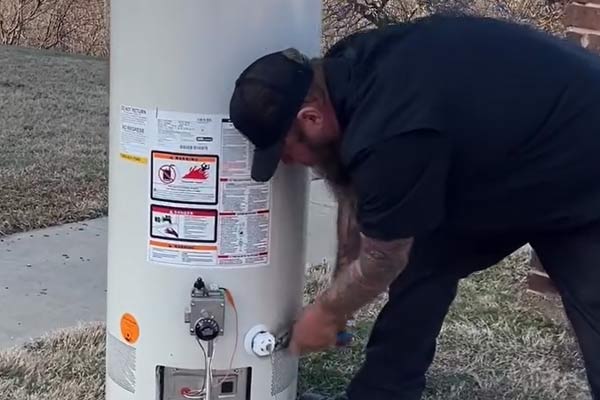
Softening reduces scale in a tank, which extends its life — that’s the main reason it’s worth doing in this area. But softened water can also increase the rate at which the anode rod is consumed, and some manufacturers specify particular anode types for softened water.
Practically: mention your softener when a water heater is installed so the right anode is fitted, and have the rod checked at a normal service interval. It’s a small detail that most installers never ask about.
Find Out What Your Water Actually Is
Tell us your city and what you’re seeing. We’ll test at your address before sizing anything, because that’s the only sound basis for it.
Water Softener Installation Near You
We install and service water softeners across the DFW metroplex, including:
Flower Mound · Little Elm · Frisco · Plano · McKinney · Carrollton · Denton · Lewisville · Allen · Richardson · Prosper
More on water treatment systems · water heater repair
Water Softener FAQs
How do I know how hard my water is?
Start with your city’s annual Water Quality Report, which publishes an average figure for its supply and is free to look up. For sizing a softener we test at your address, because the published average doesn’t account for variation within a city — in Flower Mound, which receives water from two different wholesalers, it can differ noticeably across town.
What size water softener do I need?
It’s calculated from your hardness in grains per gallon multiplied by your household’s daily water use, which gives the grain capacity the unit needs between regenerations. Bathroom count and occupancy drive the water-use side. This is why a correct hardness figure matters — an error there produces a wrongly sized system.
Do salt-free water softeners actually work?
They work at reducing scale buildup, but they don’t soften water. Salt-free systems are conditioners — they alter hardness minerals so they’re less likely to adhere to surfaces, but the minerals remain in the water and a test will read the same hardness. If you want the soft-water feel and an end to spotting, you need a salt-based ion exchange system.
Why is my water softener using no salt?
Most often salt bridging — a hard crust has formed across the salt, leaving a gap beneath it so no salt is in contact with the water. The tank looks full but no brine is being made. Carefully breaking the crust with a broom handle often resolves it, and that’s worth trying before calling anyone.
Why is my softener suddenly using far more salt than usual?
Typically a control valve fault causing excessive or continuous regeneration, or a setting that’s been changed. Occasionally a leak in the brine line. It’s worth diagnosing rather than just buying more salt, because a unit regenerating constantly is also wasting water.
How long does a water softener last?
Fifteen to twenty years with maintenance. The resin itself typically lasts ten to fifteen, faster on chlorinated municipal supply, and replacing resin on an otherwise sound unit is usually cheaper than a new system.
Will a water softener make my water taste salty?
It shouldn’t. Ion exchange adds a small amount of sodium proportional to your hardness — noticeable only at very high hardness levels. Water that genuinely tastes salty usually indicates a fault, most often a control valve stuck in regeneration.
Is softened water safe to drink?
Yes for most people. The sodium added is small relative to a normal diet. If you’re on a sodium-restricted diet, a potassium chloride alternative to salt is available, or you can leave the kitchen cold tap unsoftened and use a reverse osmosis system for drinking water.
Do I need a plumbing permit to install a water softener?
Requirements vary between cities in this metro, and several require contractor registration before a permit can be submitted at all. We check for your city and pull whatever is needed.