
Short version: yes, tunneling beats cutting on a post-tension slab. That part isn’t really debatable.
But the question is set up wrong, and if you’re the homeowner staring at a quote right now, the reframe matters more than the answer. The choice usually isn’t tunnel versus cut. It’s reroute versus tunnel. And which of those two is right comes down to something most people never get told: whether the leak is in a water line or a drain line.
More on that below, because it’s the part that decides your bill.
First, is your foundation actually post-tension?
Worth confirming before anyone quotes you anything, because homeowners and plumbers both get this wrong.
A post-tension slab is reinforced with high-strength steel cables — tendons — that are tightened after the concrete cures. Conventional slabs use rebar sitting passively in the concrete. The tendons are under serious, ongoing load. That’s the whole design.
Three ways to check:
Look for the stamp. Post-tension slabs are supposed to be marked, usually near the garage door, with wording along the lines of “Post Tensioned Slab — Do Not Drill, Cut, or Core.” Sometimes it’s been painted over or covered by flooring. Sometimes it was never stamped at all.
Check the slab edge. This is the reliable one. Post-tension slabs typically have small anchor heads along the perimeter every three to five feet. They’re often patched over with grout, so you’re looking for a regular pattern of round patches rather than the anchors themselves.
Check the build year. Post-tension became common in DFW residential construction from roughly the mid-1990s onward. If your house went up in 2004 in Frisco or Prosper, the odds are high, and the same goes for most of Little Elm and the newer half of Allen. If it’s a 1978 ranch in Richardson, probably not. Older Plano and the 1970s and 80s stock in Lewisville mostly predate it too.
If you’re still unsure, the city’s building department will usually have the plans.
Why cutting is off the table
We don’t cut post-tension slabs. Neither should anyone else, and this isn’t a liability-driven overcaution.
Those tendons are under enormous tension. Cut one with a concrete saw and it doesn’t just go slack. It releases that energy violently, and it can rip through the surrounding concrete on its way out. People have been badly hurt by this.
And that’s just the immediate danger. Sever a tendon and you’ve compromised the structural system holding your foundation together, in a way that is expensive and awkward to put right. You’d be turning a plumbing repair into a foundation repair.
Yes, ground-penetrating radar can map tendon locations, and there are situations where a specialist opens a post-tension slab with the cables scanned and avoided. It’s done. But for a residential slab leak, when tunneling and rerouting both exist as alternatives, the risk buys you nothing.
So: two real options.
The thing that actually decides it: what kind of line is leaking
Here’s what most articles on this skip.
If it’s a water supply line, rerouting is usually the better answer. You abandon the failed section under the slab and run new pipe overhead through the attic or through walls, which is routine water line repair work. Nobody digs. Nobody cuts. That run is permanently out of the slab, so it can’t fail there again. On a post-tension foundation this is frequently both the cheapest and the lowest-risk option, and it’s often what we’d recommend.
If it’s a drain or sewer line, rerouting generally isn’t available. Drains run on gravity, at a set slope. You can’t lift a sewer lateral into the attic. To reach a broken drain under a slab you either cut down to it or tunnel under to it, and on a post-tension foundation that leaves tunneling. Depending on the pipe’s condition, relining it in place is sometimes an option worth asking about.
That’s the fork. Supply leak, think reroute first. Drain leak, think tunnel.
Which is also why the first thing that should happen is finding out which one you have. A hot spot on the floor and a jumping water bill point at a pressurised supply line. A sewer smell, several slow fixtures, or damp with no pressure loss points at drainage. Leak detection and hydrostatic testing sort that out before anyone prices excavation.
If a company quotes you a tunnel before establishing which system is leaking, that’s a reasonable moment to pause.
What tunneling actually involves
People picture something more dramatic than it is.
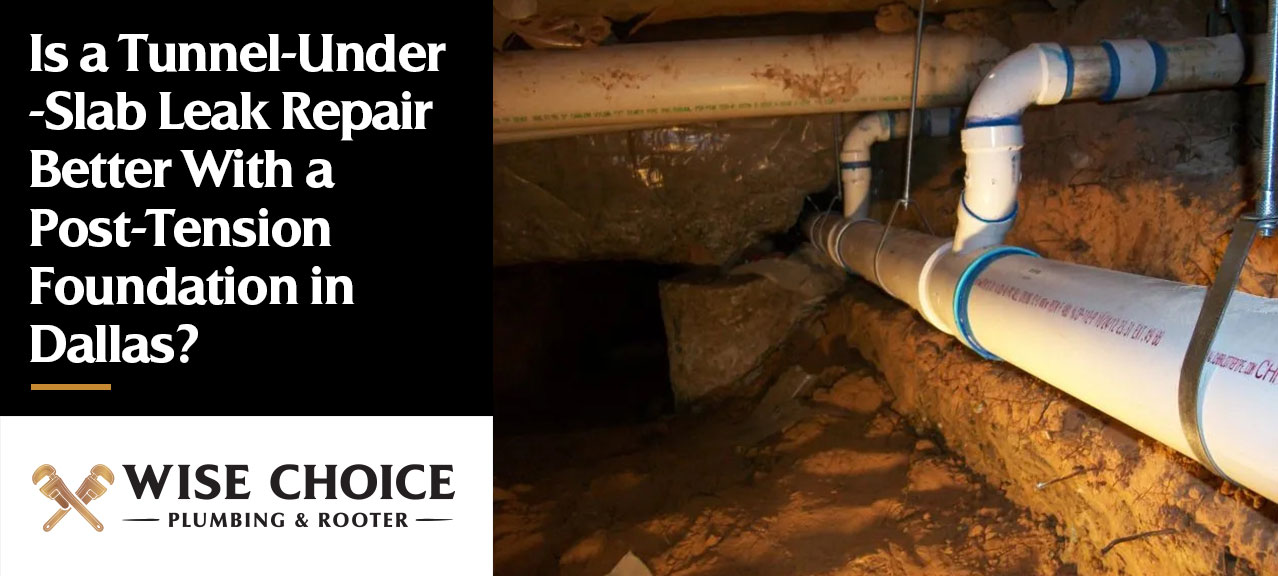
A pit is dug outside, against the foundation, near where the leak has been located. From there a tunnel is dug horizontally underneath the slab — big enough for someone to work in, following the line of the pipe. The repair happens from below. Afterwards the tunnel is backfilled and compacted, and the pit is closed.
Your floors are never touched. You generally stay in the house the whole time.
The real cost is depth and distance. Tunneling runs somewhere in the region of $300 to $500 per linear foot. A leak six feet in from the exterior wall is a different project from one under the middle of the house. That’s the number that moves your quote more than anything else, and it’s why the leak being located precisely matters so much before anyone starts.
Backfill quality is the thing to ask about. A tunnel under your foundation has to be properly backfilled and compacted afterwards. Done badly, you’ve created a void under your slab in expansive clay soil, which is the ingredient list for foundation movement later. Ask how they backfill. Ask whether it’s included in the price. A vague answer tells you something.
When tunneling is the wrong call
It isn’t automatically right, even on a post-tension slab.
When the leak is deep under the interior. Cost scales with distance. At some point the tunnel costs more than rerouting the whole line, or even repiping.
When there are multiple leaks. More than one failure usually means the pipe itself is at its age rather than one spot being unlucky. Tunneling to three separate points is expensive. A repipe may cost less and it ends the problem.
When there’s hardscaping in the way. A pool deck, a patio, or mature landscaping at the access point can make tunneling more disruptive than it sounds.
When it’s a supply leak and a reroute is available. Covered above, but it bears repeating, because tunneling gets quoted for supply leaks more often than it should.
About insurance
Worth a call before you authorise anything.
Homeowner policies vary a lot here. Many cover the damage water causes but exclude the pipe repair. Some cover access costs — the tunneling or the slab work — even where they won’t pay for the pipe. That one clause can change which option makes financial sense.
Get whatever is found documented properly, with photographs and written findings. If you end up filing, the difference between a clean claim and a fight is usually the paperwork.
What to ask before you authorise anything
If you take one thing from this, take this list.
- Is my foundation actually post-tension? Ask how they know.
- Is the leak in a supply line or a drain line? They should be able to tell you, and how they established it.
- How precisely have you located it? “Somewhere under the kitchen” is not a location. It should be within inches.
- Can this be rerouted instead? If the answer is no, ask why.
- How far in is the tunnel, and what’s the per-foot cost?
- How will the tunnel be backfilled and compacted, and is that in the price?
- What’s the plan if you find a second leak once you’re under there?
Honest answers to those seven get you most of the way to a good decision. Vague ones are their own answer.
One last thing about waiting
We understand why people put this off. None of the options are cheap and none of them are fun.
But a slab leak running under a post-tension foundation in North Texas clay is doing something while you decide. Water changes the moisture content of the soil supporting your slab, and this soil moves a great deal with moisture. A foundation designed around tensioned cables carrying a specific load is not improved by the ground underneath it shifting for six months.
The plumbing repair is almost always cheaper than the plumbing repair plus the foundation repair.
Frequently asked questions
Can you ever cut into a post-tension slab? A specialist can, with the tendons mapped by ground-penetrating radar first and the cut placed to avoid them. It happens on commercial work and in situations where there’s genuinely no alternative. For a residential slab leak with tunneling and rerouting both available, the risk isn’t worth taking.
What happens if a plumber cuts a post-tension cable? The tendon is under heavy tension, so it releases suddenly and can damage the surrounding concrete as it goes. It’s a genuine injury risk to whoever is standing there. Structurally, you’ve weakened part of the system holding your foundation together, and repairing that is specialist work costing considerably more than the plumbing did.
How do I know if my house has a post-tension foundation? Check for a stamp near the garage door, look along the slab edge for a regular pattern of anchor points or patched circles every three to five feet, and check the build year. Post-tension became common in DFW homes from around the mid-1990s. Your city’s building department will have the plans if you want certainty.
Is tunneling safe for my foundation? When it’s done properly, yes. The risk isn’t the tunnel, it’s the backfill. An improperly compacted tunnel leaves a void under your slab, and in expansive clay that’s an invitation to movement. Ask specifically how the backfill and compaction are handled and whether it’s included.
How much does tunneling under a slab cost? Broadly $300 to $500 per linear foot, so the distance from the exterior wall to the leak drives the number more than anything else. That’s exactly why precise leak location matters before excavation is priced.
Do I need to move out during a tunnel repair? Usually not. Almost all the work happens outside and underneath, so your floors stay intact and the house stays livable. That’s one of the genuine advantages over cutting through the slab.
Can a sewer line under a post-tension slab be rerouted instead? Generally no. Drains work on gravity and need continuous slope, so they can’t be lifted into the attic the way a pressurised water line can. Some sewer lines can be relined in place depending on their condition, which is worth asking about. Otherwise it’s tunnel or cut, and on post-tension that means tunnel.
How long does tunneling take? Depends almost entirely on distance and soil, but a typical residential tunnel to a single leak runs a few days rather than weeks. A longer run or multiple repair points extends it. You should be given a realistic window before work starts.
If You’re Looking at a Quote Right Now
Before you sign anything, find out two things: whether your foundation is post-tension, and whether the leak is in a supply line or a drain. Those two answers narrow your real options to one or two, and everything else is detail.
We locate leaks before we price access, we’ll tell you when a reroute beats a tunnel, and we don’t cut post-tension slabs.
Call (945) 291-8008 or get in touch.
Wise Choice Plumbing & Rooter — Master Plumber M-46550