
Yes. This comes up constantly and the short answer is that attic reroutes are a normal, permitted repair in Dallas and across North Texas.
The confusion usually traces back to a half-remembered version of the code. There is a section about pipes in attics, and people hear about it secondhand and come away thinking attic water lines are prohibited. They aren’t. The code sets a condition, and the condition is freeze protection.
Here is what it actually says, what an inspector will look at, and where the real trade-offs sit.
What the code actually requires
The relevant provision appears in the residential code as P2603.5. In localities with a winter design temperature of 32 degrees or lower, a water, soil or waste pipe shall not be installed outside of a building, in exterior walls, in attics or crawl spaces, or in any other place subjected to freezing temperature unless adequate provision is made to protect it from freezing by insulation or heat or both.
Dallas has a winter design temperature at or below 32, so that section applies here.
Read it carefully though. It does not say no pipes in attics. It says no unprotected pipes in attics. Insulation satisfies it. That is the entire difference between a reroute that passes inspection and one that doesn’t.
What an inspector is actually looking for
Four things, roughly in order of how often they cause a problem.
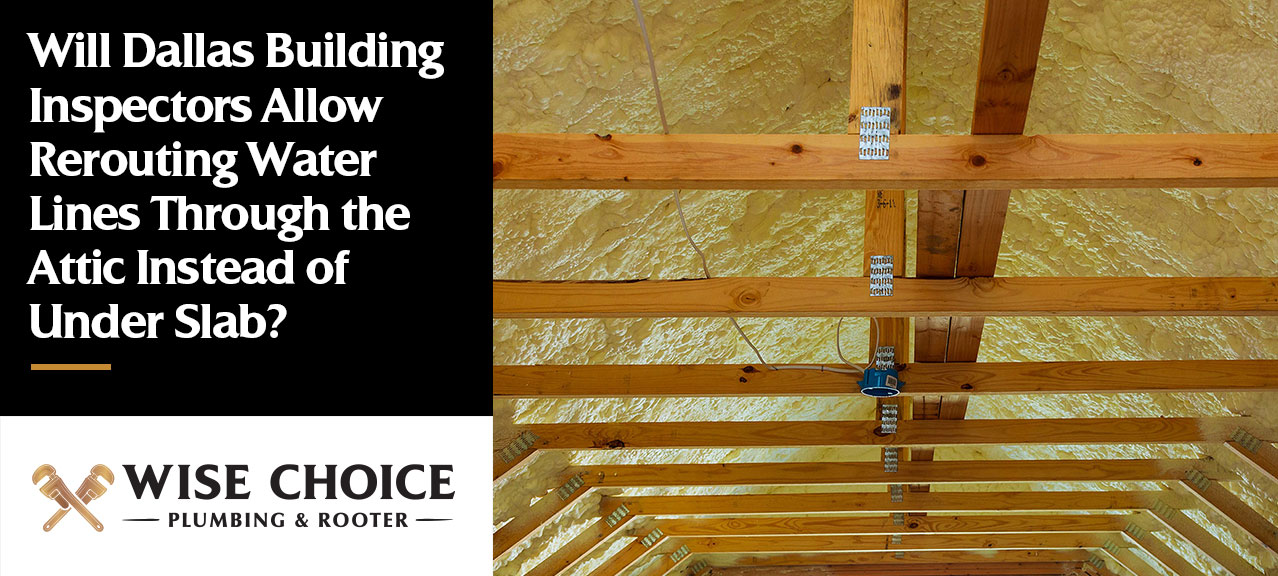
Insulation and placement. The pipe needs to be protected from freezing. In practice that means insulated pipe positioned under or within the attic insulation layer rather than sitting on top of it in open air. A line lying across the top of blown insulation with a foam sleeve on it is technically insulated and practically exposed, and that distinction matters more in a severe event than it does to a tape measure.
Support and fastening. Piping has to be properly supported to prevent sagging and breakage. Long unsupported PEX runs that droop between joists are a common correction.
Pressure test. The work gets tested before it is covered or signed off. Your plumber is responsible for providing what the test needs and for giving the inspector reasonable notice.
Licensed work and a pulled permit. A repipe or reroute is permitted work in every city we operate in, and several require contractors to be registered with the city before a permit can even be submitted.
None of that is unusual or difficult. It is a routine inspection.
The detail that separates a good reroute from an adequate one
Fittings.
The strongest way to run a reroute is continuous PEX with no fittings in the attic. Every connection is a potential failure point, and a failure point in an attic drips onto your ceiling rather than into the ground. A plumber who plans the layout to avoid attic joints entirely is doing you a favour that will not show up on any inspection report.
Running the lines close to the ceiling and keeping adequate insulation above them matters for the same reason. So does protecting them from anyone who climbs up there later and puts a foot through the insulation.
Why a reroute often beats opening the slab
For a supply line leak, rerouting is frequently the better repair rather than a compromise.
You abandon the failed section under the concrete and run new pipe overhead. Nobody breaks concrete. Nobody tunnels. The run is permanently out of the slab, so it cannot fail there again, and any future repair on that line is accessible instead of buried.
On a post-tension foundation it is usually the clear answer, because cutting into the slab is genuinely hazardous and the alternative is excavating from outside. If your home was built from roughly the mid-1990s onward in this area, that may well apply to you, and it is worth understanding how post-tension slabs change the options before anyone quotes you.
The honest trade-offs
Two, and neither is a reason to avoid it.
A leak in the attic shows up on your ceiling. A slab leak hides underground and does its damage to soil. An attic leak lands on drywall. That argues for fewer fittings and better materials, not for leaving the line under the slab.
Freeze exposure is real in a severe event. North Texas attics got cold enough during the February 2021 storm to burst lines that had been fine for decades. Proper insulation placement is what manages that, and it is the reason the code says what it says.
What to ask before you authorise one
Ask whether the water line will run continuous with no fittings in the attic. Ask where exactly it will run and how it will be insulated. Ask whether the permit is included and who schedules the inspection. And ask what happens to the abandoned section under the slab, which is normally capped and left in place rather than removed.
If you are weighing a reroute against a spot repair or a tunnel, the leak needs locating precisely first, because where it sits changes which option is cheapest.
Our plumbers in Dallas handle reroutes, pull the permit, and schedule the inspection as part of the job.
Call (945) 291-8008 or get in touch.
Wise Choice Plumbing & Rooter, Master Plumber M-46550