
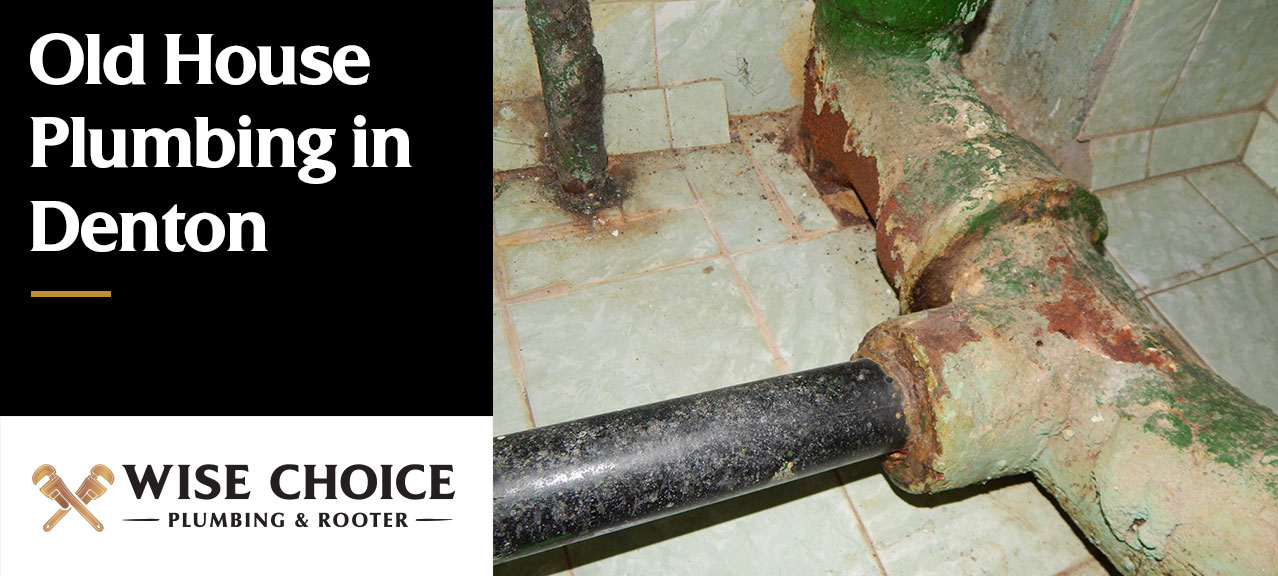
Denton has some of the oldest housing in the county. In the 76201 core, the average single-family home is about 61 years old — against a Denton County average of 22 and a Texas average of 36.
If you own one of those houses, the plumbing in it was installed when Eisenhower or Kennedy was president. It has done well to get this far.
Here’s what tends to fail, roughly in what order, and which parts you can keep an eye on yourself.
First, find out what you actually have
Before anything else, look up the year your house was built. The Denton Central Appraisal District has it, it’s free, and it takes two minutes.
That one number tells you most of what’s under your floor.
Then go look at some pipe. Check the garage, a utility closet, or under a sink where supply lines are exposed:
- Dull grey metal, a magnet sticks to it — galvanized steel. Pre-1970s.
- Obvious copper — 1970s through about 2000.
- Flexible plastic, usually white, red, or blue — PEX. Post-2000.
For drains, you’ll rarely see them, but the build year is a reliable guide. Homes through the 1970s got cast iron, with clay tile outside on the oldest properties. Later construction is PVC.
What each era means
Built before 1960. Galvanized steel supply, cast iron drains inside, and quite possibly clay tile out to the main. Every one of those materials is now past its design life. This doesn’t mean anything is about to burst — plenty of these systems are still working — but nothing in them owes you anything.
1960s and 70s. Mostly the same, with copper starting to appear in supply lines toward the end. Cast iron drains throughout. This covers a big share of central Denton, including much of the area around the Oak Hickory Historic District, Windsor Park, and North Lakes Park.
1980s and 90s. Copper supply, and drains transitioning from cast iron to PVC. Copper fails differently from galvanized — pinhole leaks rather than gradual restriction, which is why a house of this era is more likely to spring a slab leak than to slowly lose pressure.
2000s onward. PEX supply, PVC drains. Most of Denton’s west and south side construction. These homes call plumbers for entirely different reasons, and rarely for the ones in this article.
The order things tend to fail
Older systems don’t fall over all at once. They degrade in a fairly predictable sequence.
1. Water pressure declines, slowly
This is usually the first thing anyone notices, and it’s the most misunderstood.
Galvanized steel corrodes from the inside. Rust builds in layers on the interior wall until the opening is a fraction of the original bore. From outside the pipe looks perfectly fine. Inside, a three-quarter-inch line might have a quarter inch of usable space left.
So the complaint is “low water pressure,” but the pressure arriving at your house is normal. The pipe just can’t deliver it.
It gets worse in a recognisable order: furthest fixtures first, then upstairs, then pressure collapsing whenever someone opens a second tap. Rusty water first thing in the morning — after it’s been sitting in the pipe overnight — is the other giveaway.
Once it’s this far, cleaning doesn’t help. The fix is replacing the affected runs. More on water line repair and repiping in Denton.
2. Drains start clogging more often
Cast iron corrodes into a rough, ridged interior surface. Waste that would slide straight through smooth PVC catches on it, and every year a little more collects.
The tell isn’t a single blockage. It’s the interval shrinking. A drain that used to need attention every few years starts needing it annually, then every few months.
At that point, clearing it is treating the symptom. Worth understanding what’s actually happening in the line. More on drain cleaning in Denton.
3. Backups start coming back
If clearing a drain buys you three months at a time, you don’t have a clog. You have roots or a structural defect.
Clay tile sewer lines are short sections joined end to end. Clay soil here swells with rain and shrinks in drought, and that movement works the joints open. Roots don’t break into a sound pipe — they grow toward moisture escaping from one that’s already open, then thrive on what flows past.
Snaking punches a hole through the root mass. It grows back. That’s the whole story of a recurring Denton backup, and it’s why the fix is addressing the defect rather than the blockage. More on sewer line repair in Denton.
4. The water heater goes early
Denton runs its own water utility, and the water is on the harder end for this region. Minerals settle into a layer at the bottom of the tank, the burner has to heat through it, and the tank works harder every year.
That’s why heaters here often don’t reach the top of their 8-to-12-year range. Flushing the tank once a year genuinely helps and most homeowners can do it themselves.
What to check yourself, once a year
None of this needs a plumber.
Run the meter test. Shut off every fixture, including the ice maker and irrigation. Find the water meter, note the small dial or triangle — the leak indicator — wait 15 minutes, and look again. Movement means water is escaping somewhere.
Time a bathtub. Fill it a few inches and time how long it takes to drain. Do it every year. You’re not looking for a number, you’re looking for a trend.
Flush the water heater. Annually, especially here.
Look at exposed pipe. Green crust on copper, flaking rust on galvanized, damp at a fitting. Two minutes with a flashlight.
Read your water bill. A jump with no change in usage is the single most reliable early warning you get.
When it’s worth acting before something breaks
Most plumbing is reactive, and mostly that’s fine. Four situations where it isn’t:
Before a renovation. If you’re putting in new flooring, finding out afterwards that the line beneath it is failing is an expensive way to learn. Scope it first.
After the second backup in a year. One is bad luck. Two is a pattern, and a pattern has a cause you can see. A camera inspection in Denton shows whether you have roots in sound pipe, one cracked section, or a line at the end of its life. Those are three very different repairs.
Before you agree to any sewer replacement. This is the big one. Replacement and cleaning get quoted very differently, and you cannot tell them apart from the fixture. If a plumber quotes a full replacement without putting a camera down the line, get a second opinion and ask to see the footage.
When you’re buying an older Denton house. A standard home inspection is visual and doesn’t include the sewer line. On a house from the 1950s or 60s, that’s the most expensive thing nobody looked at.
What can wait and what can’t
Call now:
- Sewage backing up into the house
- Water actively leaking or flooding
- No water at all
- A water heater leaking from the tank body
- Gas smell — leave first, call the gas company, then a plumber
Worth attention soon, not tonight:
- Several drains slow at the same time
- A toilet that gurgles when the washer drains
- Sewage smell in the yard
- Pressure dropping noticeably across the house
- A water bill that jumped without explanation
Plan for it, don’t panic:
- One drain that’s gradually got slower
- A water heater past ten years that’s still working
- Galvanized pipe with acceptable pressure
- Knowing you have cast iron and no symptoms yet
The useful part
Knowing what’s under your house is worth more than any single repair.
If you know you have cast iron drains and galvanized supply, a slow drain stops being a mystery and becomes a data point. You can budget for a repipe instead of being ambushed by one. And when someone quotes you a large job, you’re in a position to ask better questions.
That’s most of the advantage available to anyone who owns an older house.
Own an older home in Denton and want to know what you’re working with? We’re a licensed master plumber and we spend most of our time on exactly this housing stock. We’ll scope the line, tell you what you’ve got, and give you a straight answer in writing.
Call (945) 291-8008 or get in touch.
See our Denton plumbing services.
Wise Choice Plumbing & Rooter — Master Plumber M-46550