
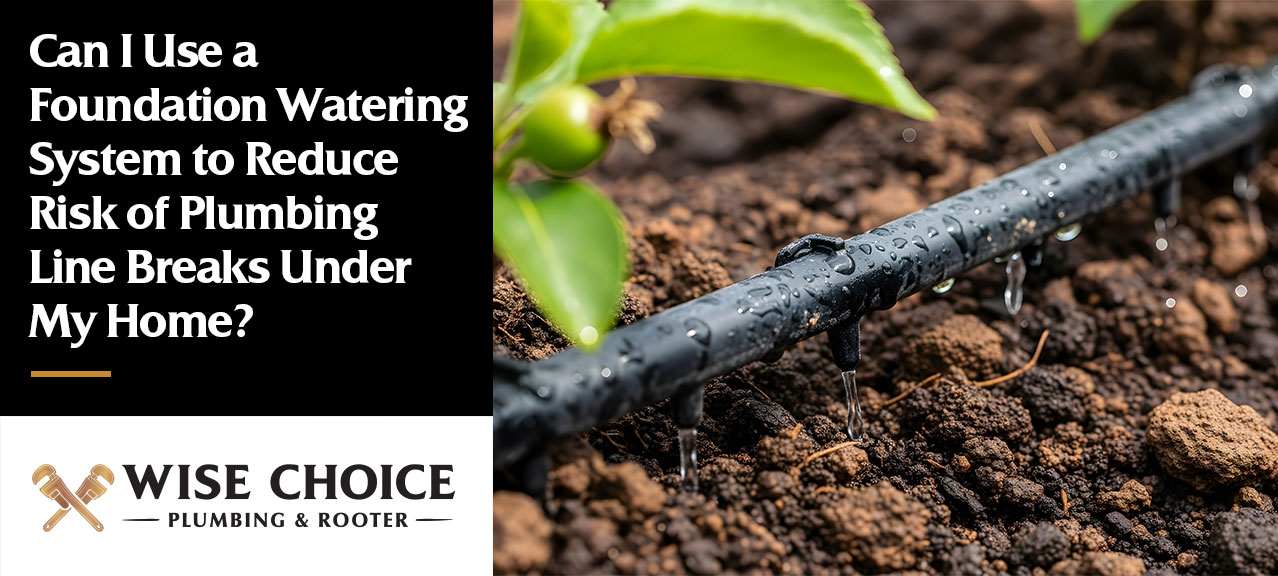
Partly, yes. It is a reasonable thing to do and it addresses a real cause. It is also widely oversold, and done badly it creates the opposite problem.
Here is the honest version of what it does and does not do.
Why under-slab pipes break here in the first place
Almost never because the pipe was bad. Almost always because the ground moved.
North Texas sits on expansive clay that swells when it takes on water and shrinks when it dries out. On untreated sites that cycle moves soil somewhere in the region of one to three inches vertically every year. Researchers at Texas A&M instrumented footings on bare clay in Arlington and measured roughly three inches of vertical movement across two years, driven purely by soil moisture going down through a dry autumn and back up through a wet spring.
Your plumbing is buried in that. Pipe is rigid, the ground is not, and over years the movement works at joints, bends and connections until something separates or cracks.
The damage comes from uneven movement rather than movement itself. Soil that rises and falls uniformly carries the pipe with it. Soil that swells on one side while it shrinks on the other shears the pipe between them.
So where watering actually helps
By evening out the moisture.
A foundation watering system keeps the perimeter soil from drying out as hard during summer, which reduces how far it shrinks, which reduces the differential between one side of your house and another. Less differential means less shear on the pipe.
That is a genuine benefit. It is also indirect, which is worth being clear about. You are not protecting the pipe. You are reducing the soil movement that stresses it.
How to do it properly
The goal is consistency, not volume. More water is not better, and this is where most people go wrong.
Soaker hose, not sprinklers. Lay it roughly twelve to eighteen inches out from the slab, following the perimeter. Sprinklers throw water against the house and onto the foundation itself, which is not what you want.
Short and frequent beats long and heavy. Twenty minutes several times a week in summer does more good than two hours on a Saturday. You are trying to hold the moisture steady, not flood it.
Use a timer. Consistency is the whole point and nobody is consistent by hand.
Watch for pooling. Water standing against the slab is a different problem, not a solution. If you see it, you are overdoing it or your grading is working against you.
Adjust seasonally. Most of the work is during drought. In a wet spring you may need to do nothing at all.
What goes wrong when it is overdone
This is the part most articles skip, and it matters because the failure mode is worse than doing nothing.
Too much water produces hydrostatic pressure against the slab, rapid soil expansion, heave, erosion, and uneven moisture that causes differential movement. You can create exactly the problem you were trying to prevent, just in the other direction.
Upward movement from added water is at least as common in North Texas as downward movement from drying, and it is entirely possible to cause it with a soaker hose left running.
What it will not do
It will not fix a line that is already failing. If your pipe has corroded, separated or cracked, moisture management does nothing for it.
It will not stop a leak you already have. And if you suspect one, stop watering until it is resolved. You would be adding water to soil that is already getting too much, which is precisely the setup for heave. There is more on how an active leak moves a foundation if that is where you are.
It will not make your plumbing permanent. Cast iron and galvanized steel have finite lives regardless of how well you manage the soil around them. Watering slows a stressor; it does not change the material.
The realistic position
Foundation watering is worth doing in North Texas, particularly through a dry summer, and it is cheap. Treat it as general property maintenance that happens to be good for your plumbing rather than as plumbing protection.
If you are watering because you have already had a line break, the watering is the smaller half of the response. The larger half is finding out what condition the rest of the system is in, which usually means putting a camera down the line rather than guessing.
Our plumbers in Dallas can tell you what you are actually working with before you spend money on either.
Call (945) 291-8008 or get in touch.
Wise Choice Plumbing & Rooter, Master Plumber M-46550